


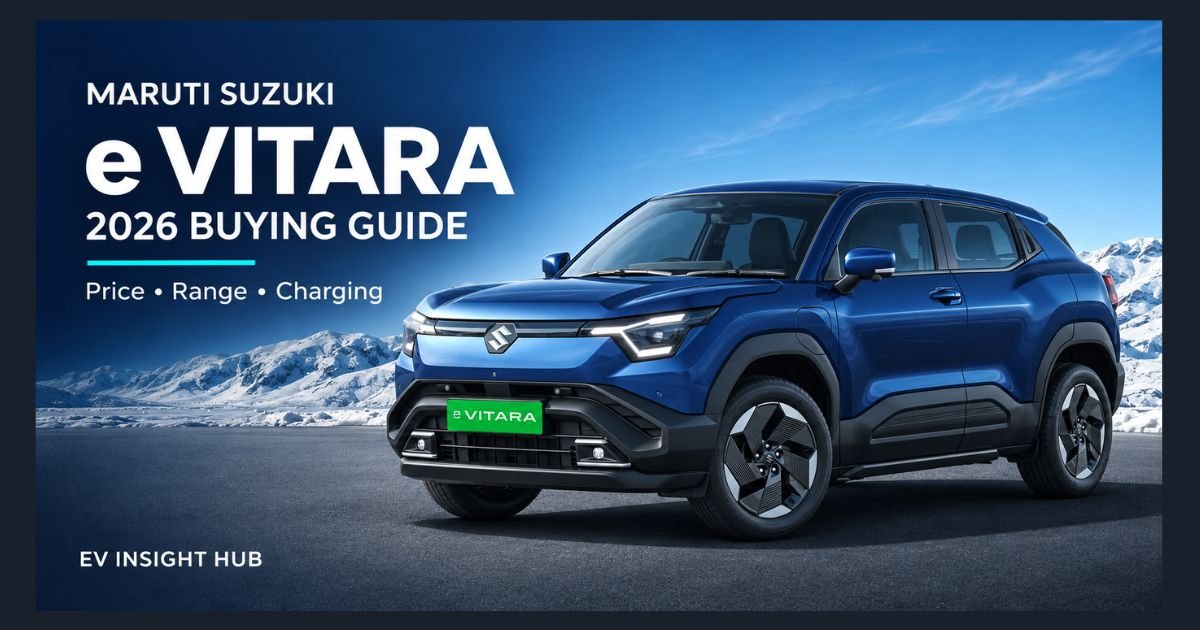
The Maruti Suzuki e VITARA is Maruti’s first fully electric car for India and its first SUV built on the new HEARTECT-e platform, which was designed from the ground up for EVs. It went on sale on February 17, 2026, through NEXA showrooms. Prices now range from ₹16.19 lakh to ₹20.21 lakh (ex-showroom, New Delhi).
The e VITARA is a five-seat compact electric SUV, about 4.3 metres long. It offers two battery packs: 49 kWh with a certified 440 km range and 61 kWh with a certified 543 km range. In addition, it’s front-wheel drive in India, although Suzuki sells an all-wheel-drive version abroad.
Maruti builds the e VITARA at its Hansalpur plant in Gujarat, which is also the export hub for Suzuki’s EVs. As a result, the e VITARA is now a global car. Maruti crossed 50,000 EV exports in October 2026, shipping to about 50 countries, including the UK, Germany, Norway, Switzerland and Japan. Europe is its largest market.On safety, the e VITARA scored 5 stars in Bharat NCAP, with 31.49/32 for adult protection and 43/49 for child protection. Higher variants also add Level 2 ADAS.
e VITARA Overview
Quick facts
| Detail | e VITARA |
|---|---|
| Body type | Compact electric SUV, 5 seats |
| Platform | HEARTECT-e (dedicated EV platform) |
| India launch | February 17, 2026 |
| Price (ex-showroom) | ₹16.19 lakh to ₹20.21 lakh |
| Variants | Delta, Zeta, Alpha, Alpha Dual Tone |
| Battery | 49 kWh / 61 kWh |
| Certified range | 440 km / 543 km |
| Drive | Front-wheel drive (India) |
| Safety rating | 5 stars, Bharat NCAP |
| Made at | Hansalpur, Gujarat |
| Exports | 50,000+ EVs to about 50 countries (Maruti, Oct 2026) |
| Rival twin | Toyota Urban Cruiser Ebella (same platform, 61 kWh only) |
- India sales began on 17 February 2026; it is not an upcoming launch.
- The current NEXA New Delhi page lists the Delta at ₹16.19 lakh and Alpha at ₹19.99 lakh before applicable on-road additions.
- The battery choices are marketed as 49 kWh and 61 kWh, with manufacturer-listed certified ranges of 440 km and 543 km respectively.
- Home charging access and your regular routes should influence the decision as much as the equipment list.
- Expired launch offers, estimated on-road prices and certified range figures need separate checks.
Sources: Suzuki’s India sales announcement, NEXA’s New Delhi price page and the official brochure linked below.
What changed during 2026?
- The February launch established the e VITARA as Maruti Suzuki’s first battery-electric vehicle offered to Indian customers. Suzuki identifies Hansalpur, Gujarat, as its production location and describes the model as a global electric vehicle.
- Pricing subsequently changed. CarWale’s 28 August 2026 report recorded a ₹20,000 increase for Delta and ₹15,000 for Zeta, taking those variants to ₹16.19 lakh and ₹17.94 lakh. The publication reported no corresponding increase for Alpha or Alpha dual-tone in that revision.
- That history matters when reading older articles or screenshots. A launch price can remain widely circulated after the current price has moved. Compare the quotation date, battery option and ownership arrangement before treating two advertised amounts as equivalent.
- October 29, 2026: Maruti Suzuki’s EV exports crossed 50,000 units since shipments began in August 2025. The e VITARA and its Toyota twin, the Urban Cruiser Ebella, now go to about 50 countries. Maruti also expanded Hansalpur’s capacity to 1 million vehicles a year.
Source: CarWale’s August price-revision report.
Maruti Suzuki e VITARA Specifications
Your current table covers the battery and charging. This full table adds dimensions, chassis and safety details.
| Specification | Delta (49 kWh) | Zeta / Alpha (61 kWh) |
|---|---|---|
| Battery (usable, brochure) | 48.8 kWh | 61.1 kWh |
| Certified range | 440 km | 543 km |
| Motor | Permanent magnet synchronous, front-mounted | Permanent magnet synchronous, front-mounted |
| Power | 105.8 kW (about 144 PS) | 128 kW (about 174 PS) |
| Torque | 193 Nm | 193 Nm |
| Transmission | Single-speed automatic | Single-speed automatic |
| Drive | Front-wheel drive | Front-wheel drive |
| AC charging (7.4 kW, 10–100%) | About 6.5 hours | About 9 hours |
| DC fast charging (10–80%) | About 45 minutes | About 45 minutes |
| Charging port | CCS2 | CCS2 |
| Drive modes | Eco, Normal, Sport + Snow | Eco, Normal, Sport + Snow |
Dimensions and chassis
| Dimension | e VITARA |
|---|---|
| Length | 4,275 mm |
| Width | 1,800 mm |
| Height | 1,640 mm |
| Wheelbase | 2,700 mm |
| Ground clearance | 185 mm |
| Turning radius | 5.2 m |
| Kerb weight | About 1,820 kg (61 kWh) |
| Boot space | About 238–310 litres (sources differ*) |
| Front suspension | MacPherson strut |
| Rear suspension | Multi-link |
| Brakes | Disc, front and rear |
| Tyres | 225/55 R18 (alloy wheels) |
| Rear seat | 40:20:40 split |
*Autocar India measured about 238 litres, while some listings quote 310 litres. Check the boot in person if luggage space matters to you.
Key features (top variants)
- 10.1-inch touchscreen with wireless Android Auto and Apple CarPlay
- 10.25-inch digital driver’s display
- Infinity sound system with a subwoofer
- Ventilated front seats and a 10-way power driver’s seat (Alpha)
- Fixed glass roof, wireless charger (Zeta and above), automatic climate control
- 360-degree camera and Level 2 ADAS (Alpha), including adaptive cruise control, lane keep assist and autonomous emergency braking
- Seven airbags, ESC, TPMS, hill-hold and ISOFIX mounts
Feature lists vary by variant, so check the current NEXA brochure before booking.
Colours
- Monotone (7): Arctic White, Bluish Black, Grandeur Grey, Land Breeze Green, Nexa Blue, Opulent Red, Splendid Silver
- Dual-tone (4): Arctic White, Land Breeze Green, Opulent Red and Splendid Silver, each with a Bluish Black roof
Warranty: 8 years / 1,60,000 km on the battery and 3 years on the vehicle, which can be extended for a fee.
e VITARA vs Rivals
| Electric SUV | Starting Price (ex-showroom) | Battery | Claimed Range |
|---|---|---|---|
| Maruti e VITARA | ₹16.19 lakh | 49 / 61 kWh | 440 / 543 km |
| MG Windsor EV | ₹14.00 lakh | 38 / 52.9 kWh | 332 / 449 km |
| Tata Curvv EV | About ₹17.19 lakh | 45 / 55 kWh | 430 / 502 km |
| Hyundai Creta Electric | About ₹18.03 lakh | 42 / 51.4 kWh | 420 / 510 km |
| MG ZS EV | ₹17.99 lakh | 50.3 kWh | 461 km |
| Mahindra BE 6 | About ₹18.90 lakh | 59 / 79 kWh | 548 / 683 km |
Rival prices are from Autocar India’s February 2026 comparison and may have changed since.
Overall, the e VITARA offers the second-largest battery in this group after the BE 6, along with a strong 5-star safety rating. However, the MG Windsor EV is cheaper to buy, and the BE 6 goes further on a charge.
e VITARA price: compare the same ownership arrangement
| Variant | Battery designation | Ex-showroom price reference |
|---|---|---|
| Delta | 49 kWh | ₹16.19 lakh |
| Zeta | 61 kWh | ₹17.94 lakh |
| Alpha | 61 kWh | ₹19.99 lakh |
| Alpha dual-tone | 61 kWh | ₹20.21 lakh |
NEXA’s page does not separately identify every paint configuration in its headline range. Confirm the colour, exact variant and invoice-date price in writing rather than assuming the standard Alpha figure includes a dual-tone finish.
What should the on-road quotation include?
Ask the dealer to separate the vehicle price, registration and applicable taxes, insurance, optional accessories, charging installation and finance-related charges. Any state EV concession should be checked against the rules and eligibility applicable when the vehicle is registered.
Keep optional packages separate from compulsory charges. Two quotations are only comparable when they cover the same vehicle, insurance protection, charger installation scope and ownership arrangement.
BaaS explained: a lower entry price is not the full cost
Maruti Suzuki’s launch announcement advertised an introductory Battery-as-a-Service arrangement starting at ₹10.99 lakh, with battery EMI quoted at ₹3.99 per kilometre. The announcement attached conditions and identified an introductory offer period ending on 31 March 2026.
Do not assume that those February terms remain available in November. Request the current lender agreement and a complete repayment illustration before comparing BaaS with buying the battery through a conventional purchase.
- Check minimum billable distance, payment tenure and any annual kilometre commitment.
- Ask how electricity, taxes and other charges are treated.
- Confirm battery ownership, early settlement, resale and transfer conditions.
- Compare total payments over your expected ownership period, not just the initial amount.
Illustration only: multiplying the original ₹3.99/km headline by 1,000 km gives ₹3,990. This is simple arithmetic, not a current EMI quotation or total monthly running cost. Contract minimums and other charges can change the amount payable.
Source: Maruti Suzuki’s February launch announcement and offer conditions.
Battery options, range and charging time
| Specification | Delta | Zeta / Alpha |
|---|---|---|
| Marketed battery size | 49 kWh | 61 kWh |
| Brochure-listed capacity | 48.8 kWh | 61.1 kWh |
| Certified range listed by manufacturer | 440 km | 543 km |
| Motor output | 105.8 kW | 128 kW |
| Torque | 193 Nm | 193 Nm |
| 7.4 kW AC charging, 10–100% | Approximately 6.5 hours | Approximately 9 hours |
| DC charging, 10–80% | Approximately 45 minutes | Approximately 45 minutes |
Source: official e VITARA technical brochure.
A certified range figure is a comparison reference, not a promise for your route. Speed, weather, air-conditioning, gradients, passenger load and driving style affect consumption. This article does not substitute an invented “real-world range” for a properly documented road test.
For a useful test drive, reset the trip display and record the route, distance, starting charge and ending charge. Include the roads and passenger load you normally use. A short drive can reveal comfort and control preferences, but it cannot establish year-round range.
Which e VITARA variant should you shortlist?
Delta: Start here if reducing the purchase budget matters most. Decide whether the smaller battery supports your routine and occasional longer journeys before spending on higher equipment levels.
Zeta: This is the first larger-battery option in the listed range. Buyers prioritising the additional certified range should compare it with Delta before moving directly to the top trim.
Alpha: Consider it when its additional equipment is something you will actually use. The brochure places features including the 360-degree camera and listed driver-assistance functions on Alpha. Confirm the current equipment sheet for the exact vehicle offered.
Using the price references above, Delta to Zeta adds ₹1.75 lakh; Zeta to Alpha adds ₹2.05 lakh before other charges. These calculated differences help separate spending on battery choice from spending on equipment.
Safety: examine the rating and the equipment separately
Bharat NCAP’s published e VITARA assessment records 31.49 out of 32 for adult occupant protection and 43 out of 49 for child occupant protection. Its applicability listing includes Delta 49 kWh and Zeta and Alpha 61 kWh configurations.
Crash-test results describe performance under specified conditions. They do not guarantee the outcome of every collision. Check the applicability document, use suitable child restraints and confirm the equipment on the particular variant you buy.
Driver-assistance features also require attention and appropriate use. Ask for a demonstration and read the operating limitations rather than interpreting an assistance package as permission to stop supervising the road.
Source: Bharat NCAP e VITARA fact sheet and variant applicability.
Home charging should be checked before booking
A convenient charging arrangement can matter more than a small difference in advertised range. Before paying a booking amount, establish whether your parking space has permission, a suitable electrical supply and an approved installation route.
- Request a site survey and an itemised installation quotation.
- Confirm cable routing, earthing, protective equipment and any sanctioned-load upgrade with qualified installers.
- For shared parking, obtain the necessary building or association approval.
- Check public chargers on your actual routes, including access hours, payment requirements and a backup location.
Suzuki’s February announcement describes the “e for me” app and its charging-support ecosystem. Treat network totals as dated company statements: a national count does not establish that a compatible charger near your destination is available when you need it.
Calculate electricity cost using your own figures
For home charging, divide the electricity cost attributable to charging by the distance driven over the same period. Metered electricity captures charging losses that a dashboard consumption figure may not include.
For example, an assumed 18 kWh drawn from the wall per 100 km at an assumed ₹8/kWh gives ₹144 per 100 km, or ₹1.44/km. These are fictional planning inputs, not measured e VITARA consumption or a current electricity tariff. Add public-charging fees and any battery-financing payments separately.
Warranty and delivery checks
The launch release specifies battery cover of eight years or 1,60,000 km, whichever comes first. Ask for the current warranty booklet and confirm eligibility, exclusions, transferability, maintenance requirements and how any battery-capacity claim is assessed.
Do not treat battery cover as identical to whole-vehicle cover. Also request written confirmation of the delivery estimate, manufacturing details, charger arrangements, outstanding service campaigns and any offer included in your quotation.
Compare the electric choice with your existing shortlist
If you are considering several Maruti models, begin with our Maruti Suzuki cars, SUVs and electric vehicles guide. It helps place the electric SUV within the wider brand range.
For buyers still weighing charging access against conventional refuelling, our Maruti Suzuki Fronx buying guide provides another ownership format to consider. Compare total expenditure and practicality; the two models are not direct equivalents simply because they share a manufacturer.
e VITARA Pros and Cons
| Pros | Cons |
|---|---|
| Up to 543 km certified range | Rear headroom is tight for tall passengers |
| 5-star Bharat NCAP and Level 2 ADAS | Boot space is small for the segment |
| Smooth, easy city driving | Firm, busy ride at highway speeds |
| Big step up in cabin quality for Maruti | Noticeable wind and tyre noise |
| 8-year battery warranty and the NEXA network | No paddle shifters to adjust regen |
Conclusion: buy around your charging routine
The e VITARA deserves a shortlist when its purchase cost, charging arrangements and cabin meet your needs. Choose the battery first, assess the equipment second and compare financing only after you understand the complete payment obligation.
Before booking, collect three things: an itemised vehicle quotation, a charging-installation assessment and the applicable finance and warranty documents. Save this checklist or share it with the person helping you compare quotations.
Frequently asked questions
Has the Maruti Suzuki e VITARA launched in India?
Yes. Suzuki confirms that Indian sales began on 17 February 2026. It should no longer be described as an upcoming Indian launch.
What is the e VITARA starting price?
NEXA’s New Delhi page lists Delta at ₹16.19 lakh before applicable on-road additions, checked on 4 November 2026. The older ₹10.99 lakh introductory BaaS headline involved separate battery payments and is not a like-for-like full purchase price.
What is the claimed e VITARA range?
The manufacturer lists 440 km for the smaller battery and 543 km for the larger battery. These are certified figures; actual distance depends on driving and operating conditions.
How long does e VITARA charging take?
The brochure estimates DC charging from 10–80% at approximately 45 minutes. Its 7.4 kW AC estimates cover 10–100%, so the AC and DC figures should not be compared as identical charging sessions.
Which e VITARA variant is best for me?
Shortlist Delta for the lower purchase cost, Zeta for the larger battery without moving to Alpha, and Alpha if its additional equipment justifies the premium for your needs. Check current specifications and test the actual vehicle before deciding.
Disclaimer: Information verified as of 6 November 2026. This is a researched India-market buying guide, not a firsthand road test. Prices, offers and delivery estimates should be reconfirmed before booking.
Also Read: Maruti Suzuki Fronx: Price, Mileage, Variants and Buying Guide
Honda Super-One Review: Price, Range, Capacity, India launch and Driving Experience

