


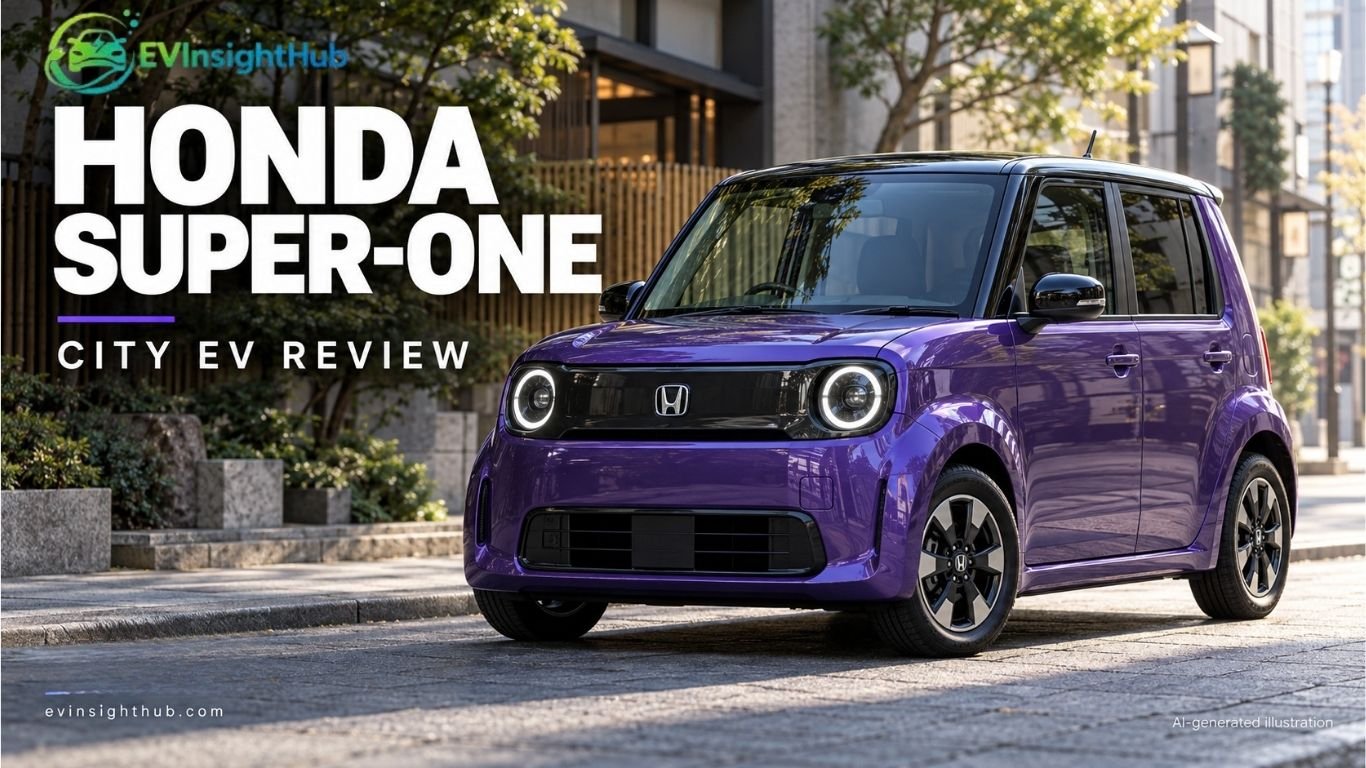
Super-One is Honda’s first small electric vehicle to hit the Australian market, and it’s quite unlike the majority of its competition. Honda isn’t aiming to hit large volume goals with the vehicle, but is developing a small, light EV for everyday driving pleasure. It comes with a 29.6 kWh battery, can produce up to 70 kW in Boost mode and is claimed to achieve 202km of WLTP range. The price to drive away in Australia is $36,900, and it will be available for delivery from October 1, 2026. Honda is yet to announce a date for its launch in India, but auto portals have estimated the price at ₹20-21 lakh for Indian buyers. The seven-speed gearbox simulation and retro design of the 80s Honda City Turbo II are its main talking points.
Honda Super-One Specification
| Specification | Detail |
| Body type | Four-seat compact electric hatchback |
| Base platform | Honda N-ONE e: (kei car) |
| Battery capacity | 29.6kWh lithium-ion |
| Power | 47kW (Normal), 70kW (Boost) |
| Torque | 162Nm |
| Claimed range | 202km WLTP / 253km NEDC / 274km WLTC (Japan) |
| Energy use | 121Wh/km (claimed) |
| DC fast charging | Up to 50kW (15–80% in about 30 minutes) |
| AC charging | 6.6kW single-phase / 10kW three-phase |
| Weight | 1,093kg (Australian spec) |
| Length / Width / Height | 3,582mm / 1,573mm / 1,616mm |
| Boot capacity | 162L (seats up) to 967L (seats folded, to roof) |
| Price (Australia) | $36,900 (Mono) / $37,400 (Two-Tone) drive-away |
About the Honda Super-One
This tiny, boxy car is Honda‘s first electric vehicle arrived in Australian market, and it’s quite unlike the majority of its competition. Honda isn’t aiming to hit large volume goals with the vehicle, but is developing a small, light EV for everyday driving pleasure.
The Super-One was first introduced at the 2025 Japan Mobility Show, and will be available for purchase in Japan on May 21, 2026. Since then it has spread to Australia, Thailand and Brunei. The Super-N EV is the same model sold by Honda in the UK.
It’s a kei car, beginning life as the Honda N-ONE e. However, Honda didn’t simply rebadge it. The Super-One is mounted on a wider chassis than the N-ONE e and Honda incorporated a number of features that are just for fun.
Although it’s a small electric car, there’s meaning in the name, as well. Honda describes “Super” as exceeding the typical EV and mini-vehicle standards, while “One” is referring to a value found only by Honda. It is part of a family of EVs in Japan, alongside the N-VAN e and N-ONE e, and the new Insight. But Honda has further intentions in the future, with an electric N-BOX scheduled for 2028
Latest Updates: Australian Launch and Demand
The Super-One’s debut has become one of Honda’s most successful triumphs of 2026. So far, this is what has come to pass:
- Strong early interest – just under 7,000 Australians registered an interest, an amount that surpassed that of the Civic Type R and the Prelude.
- Advance booking before launch : Honda’s entire allocation sold prior to the official launch.
- Very limited stock : The initial delivery – 130 cars – was sold out within hours.
- Deliveries began: Honda began accepting orders for later production as first customers were accepted October 1, 2026.
In the meantime, there should be an increase in stock in 2027. If you didn’t get the first one, then you’ll probably have to be patient.
Design: Retro Charm in a Tiny Footprint
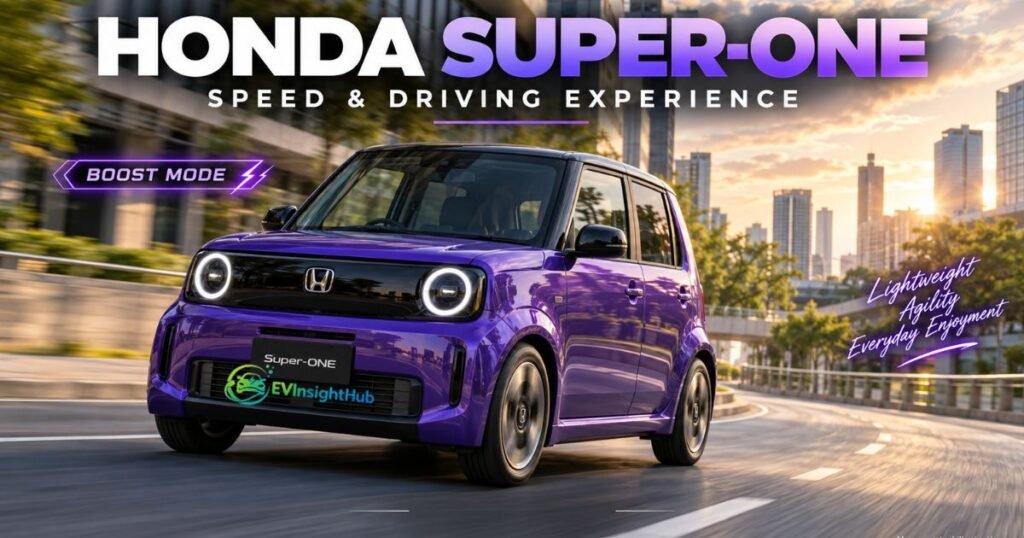
Perhaps the most shareable aspect of the Super One is the styling. Pumped-out wheel arches, an upright nose and round headlights give it a cheeky, cartoon-like appearance. Despite this, the design is fairly cohesive.
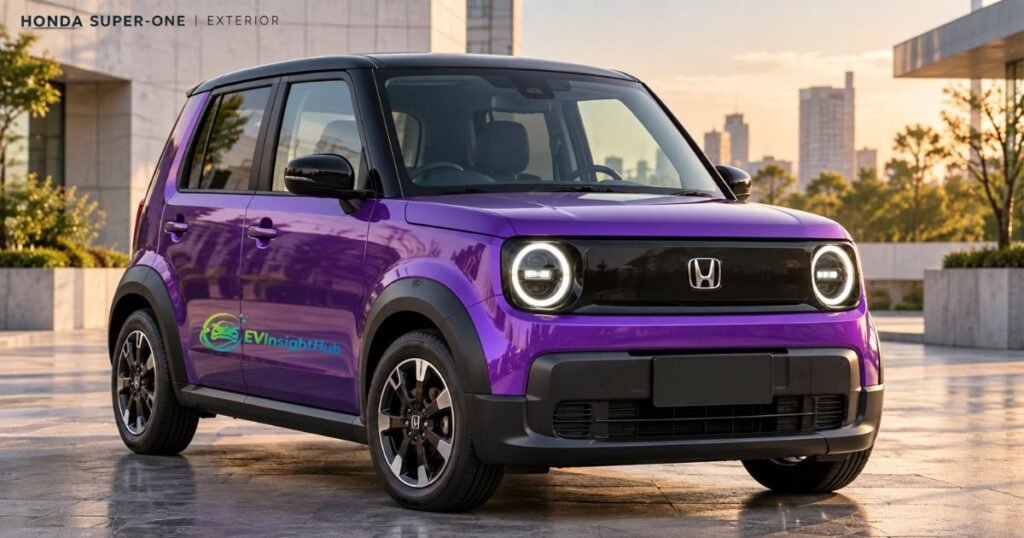
The Honda was blatantly inspired by the 1980s “Bulldog” Honda City Turbo II. This can be observed in the boxy body and broad, planted feet. The Super-One is 100mm wider and 185mm longer than the N-ONE e while weighing 185kg — the same as the Super-One e — and being fitted with 15-inch alloy wheels.
The design also performs a certain function. The blister fenders are encased around the wide tires, and Honda put front and rear air ducts to assist with stability. Other smart touches includes:
- A charging port hidden in the front grille.
- Recycled plastic from previous Honda car parts were employed for the grille and rear light housings.
- Bold colors in Japan, such as Boost Violet Pearl and Charge Yellow, and also 2-tone, black roof colors.
- In terms of ownership, it is a definite advantage. A wide 1573mm car fits in tight garages, narrow lanes and almost anywhere. In a city, it’s much more important than a large battery.
Interior, Technology and Comfort
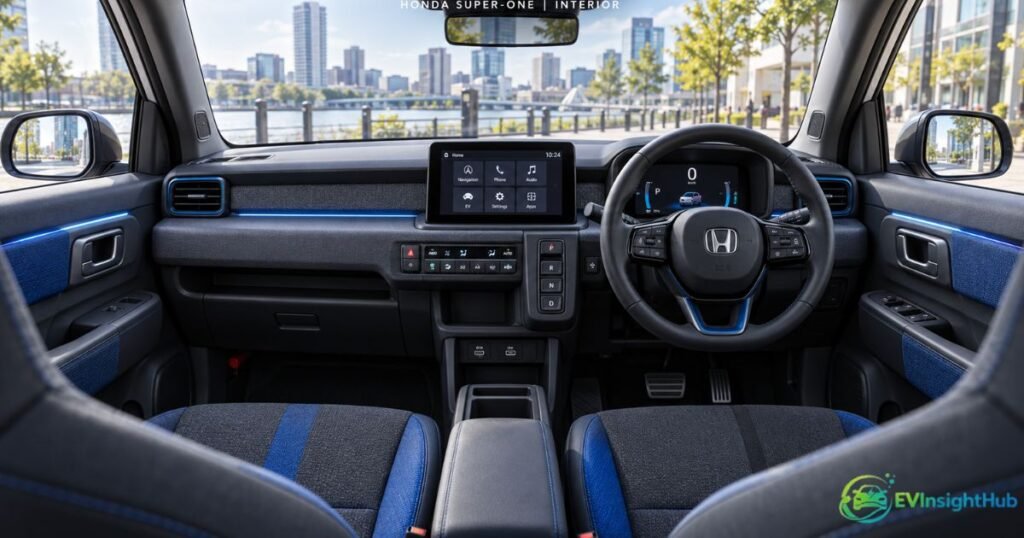
Inside, Honda continues the retro theme without skipping modern features. Standard equipment in Australia includes:
- 9.0-inch touchscreen with Google built-in.
- Wireless Apple CarPlay and Android Auto.
- Seven-inch digital driver display.
- Eight-speaker Bose sound system.
- Heated front seats and heated steering wheel.
- Sports seats with colourful trim.
The Bose system deserves a special mention. It includes a 13.1-litre subwoofer in the cargo area, and the Super-One is the first compact Honda in Japan with Bose audio as standard.
Another thoughtful choice is the physical climate control panel, styled to look like an old cassette deck. Buttons are simply easier to use while driving than menus buried in a screen.
One comfort note stands out from early drives. The driver’s reviewer, who is 6’5″, had no headroom problems, but found the large side bolsters on the front seats tight around the hips. Therefore, broader-framed buyers should sit in one before ordering.
Capacity: Battery, Seats and Boot Space
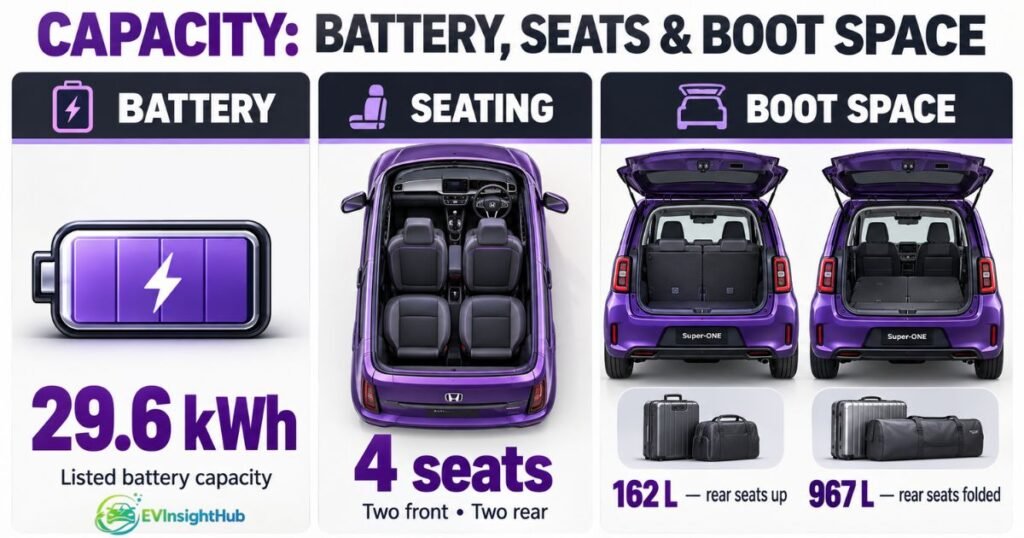
Capacity is where the Super-One asks for realistic expectations. Let’s break it down into the three areas buyers ask about most.
Battery Capacity
The Super-One uses a 29.6kWh lithium-ion battery that drives the front wheels. That’s small by modern EV standards. However, the car’s light weight helps it use energy efficiently, with Honda claiming 121Wh/km.
Seating capacity and cargo space
The Super-One seats four, with a 162-liter boot that expands to as much as 967 liters when the rear seats are folded. Those capacities describe different seating arrangements; maximum cargo volume is unavailable while carrying four people.
Honda’s Magic Seats allow the rear cushions to lift for taller loads or the seats to fold down for extra cargo space. That flexibility helps a small car handle varied errands.
It does not remove the need to test your own luggage. Bring the stroller, suitcase or equipment you carry most often. A quoted liter figure cannot show whether an awkwardly shaped item fits through the tailgate.
EVinsighthub also highlighted limited front-seat travel for taller occupants and the absence of steering-wheel reach adjustment. Tall drivers should check their preferred seating position before assuming a high roof guarantees a comfortable fit.
For a couple who occasionally carries two passengers, the layout may be enough. A household requiring five seats has a straightforward reason to look elsewhere.
Boot Capacity
With all seats in use, the boot holds only 162 litres. Fortunately, Honda’s Magic Seats add flexibility. Folding the rear seats opens up 618 litres to the window line, or 967 litres all the way to the roof.
| Configuration | Boot Capacity |
| All four seats up | 162 litres |
| Rear seats folded (to window) | 618 litres |
| Rear seats folded (to roof) | 967 litres |
In practice, that makes the Super-One a capable two-person car with surprising cargo room. Alternatively, it works as a four-seater for short trips with light bags.
Driving experience: the case for low-speed enjoyment
The normal 47 kW output rises to 70 kW in BOOST mode. Honda combines that increase with synthetic engine sound and simulated seven-speed shifting. The physical transmission remains a reduction gearbox; the shifting sensation is electronically created.
It reported approximately 14.5 seconds for 0–100 km/h at normal output and around 10 seconds in BOOST during his overseas review. These are reported figures, not acceleration measurements produced by EV Insight Hub.
The stronger argument for the Super-One is how it uses modest performance. In everyday city driving, responsiveness, visibility and steering can matter more than a headline sprint time.
WhichCar’s Australian first drive praised steering feedback and the playful chassis. Experts also found it responsive and enjoyable around town. These observations support the car’s driver-focused positioning, but short launch drives cannot establish long-term comfort, reliability or ownership satisfaction.
Potential buyers should try both the ordinary modes and BOOST. If the sound and shifting effects still appeal after several minutes, they add personal value. If the novelty fades, the purchase has to stand on the car’s other qualities.
Light Weight Is the Secret Weapon
The most important number here isn’t power. It’s weight. Honda quotes 1,090kg in Japan, which it calls the lightest in its class, along with a wide 1,345mm tread. Many EVs weigh close to two tonnes and rely on big motors to feel quick. The Super-One instead starts light, so its modest motor has far less mass to move.
Honda also tuned the chassis specifically for this model. It has a wider track, revised springs and dampers, and tyres developed together with the suspension. On paper, that recipe should deliver nimble, stable handling through corners.
Five Drive Modes
Drivers can choose between five modes:
- ECON: Maximises efficiency.
- CITY: Enables one-pedal driving with four deceleration levels.
- NORMAL: Balanced everyday driving at 47kW.
- SPORT: Sharper responses with simulated gear changes.
- BOOST: Raises output to 70kW for the strongest acceleration.
Interestingly, the steering-wheel paddles change roles depending on the mode. In Sport and Boost, they trigger simulated gear changes. In Normal and Econ, they adjust regenerative braking instead.
The Simulated Gearbox and Engine Sound
Here’s the feature everyone talks about. In Boost mode, Honda pairs a simulated seven-speed transmission with Active Sound Control, which plays a virtual engine note that responds to your throttle. Additionally, the instrument display turns from blue to purple, complete with a rev counter.
Opinions will split on this. Smooth, seamless acceleration is one of the best things about EVs, so adding fake gear changes feels odd to purists. On the other hand, some drivers miss feeling involved, and this gives them something to do. Ultimately, it’s a matter of taste, and you can simply switch it off by choosing another mode.
Range and Charging: Real-World Expectations
The Super-One’s range figures can look confusing because three different test cycles are quoted.
| Test Cycle | Claimed Range | Where It’s Used |
| WLTP | 202km | Australia, Europe |
| NEDC | 253km | Older standard, still quoted |
| WLTC | 274km | Japan |
As a rule, WLTP is the most realistic of the three. So 202km is the best baseline, and real-world range will drop further in cold weather, at motorway speeds, or with heavy air-conditioning use.
Is that enough? For many city households, yes. The average Australian drives roughly 36km per day. That means a driver who charges at home overnight could go nearly a week between charges. However, frequent highway trips or a reliance on public chargers change the picture completely.
Charging speeds are modest. DC charging peaks at 50kW, which takes the battery from 15% to 80% in roughly 30 minutes. At home, AC charging reaches 6.6kW on single-phase or 10kW on three-phase power.
In Japan, the Super-One can also act as a power source. With a dealer-option connector, it supplies up to 1,500W for appliances or emergency backup.
Cabin Technology and Safety Features
Australian equipment includes a 9-inch touchscreen, Google Built-In, wireless Apple CarPlay and Android Auto, and an eight-speaker Bose system. Heated front seats and a heated steering wheel add comfort features often associated with larger cars.
Check the interface while parked. Navigation, phone connection and climate controls should be convenient enough that you do not have to relearn basic tasks every journey.
Some expert review reported no ANCAP crash-test rating. It also described Honda SENSING assistance and six airbags. An unrated vehicle has not thereby failed a test, but buyers lack an ANCAP result to use in a direct comparison.
WhichCar identified the absence of blind-spot monitoring and rear cross-traffic alert. If either feature is important to your driving routine, verify the current local equipment list before ordering.
Safety equipment deserves separate consideration from the car’s appeal. Attractive styling and enjoyable handling do not answer questions about crash-test evidence.
Price, Warranty and Running Costs
| Item | Detail |
| Super-One Mono | $36,900 drive-away |
| Super-One Two-Tone | $37,400 drive-away |
| Japan price | ¥3,390,200 (including tax) |
| Vehicle warranty | 5 years, unlimited km |
| Battery warranty | 8 years / 160,000km |
| Roadside assistance | 5 years |
| Servicing | $199 per service (first five) |
| Service interval | 12 months or 15,000km |
The ownership package is strong. Five capped services at $199 each keep running costs low and predictable. Still, nearly $37,000 is a lot for a car with clear limits. By comparison, buyers wanting more space and range might consider larger EVs such as the Tesla Model Y in our Tesla Model Y buying guide, though at a much higher price.
Pros and Cons
| Pros | Cons |
|---|---|
| Fun, distinctive retro design | Only 202km WLTP range |
| Light weight and agile chassis | Just four seats |
| Boost mode and interactive drive modes | Small 162-litre boot with seats up |
| Excellent standard features, including Bose audio | Slow 50kW DC charging |
| Low service costs and strong warranty | High price for its small size |
| Easy to park in tight city spaces | Limited stock until 2027; India launch not yet confirmed |
Honda Super-One India: Launch Date and Expected Price
Indian EV buyers are watching the Super-One closely, and search interest keeps growing. Here’s what we know for certain and what is still speculation.
Is the Honda Super-One Launching in India?
Right now, Honda has not officially confirmed an India launch for the Super-One. However, Honda Cars India is preparing a different EV. Kunal Behl, Vice President of Sales and Marketing at Honda Cars India, said its first EV for India will be made locally and exported worldwide, with a launch in the second half of this financial year. That model is separate from the Super-One.
Meanwhile, Honda keeps expanding the Super-One into new Asian markets. In Thailand, Honda priced it at 990,000 baht, and early sales there are limited to just 30 units. This slow, small-batch rollout suggests India isn’t a near-term priority.
Honda Super-One Launch Date in India
Several Indian car portals list a tentative December 2026 launch. Still, these dates come from estimates, not from Honda. Even portals that list the price admit Honda hasn’t confirmed India plans and advise buyers to wait for an official update before booking.
Honda Super N Launch Date in India
Many Indian buyers search for the “Honda Super N.” That name comes from the UK, where Honda sells the car as the Super-N EV. In other words, the Super-N and Super-One are the same car under different badges. Accordingly, there is no separate India launch date for the Super-N.
Honda Super-One Price in India (Expected)
| Detail | Status |
| Official India launch | Not confirmed |
| Expected price | ₹20–21 lakh (estimated, ex-showroom) |
| Tentative launch window | December 2026 (portal estimate) |
| Likely import route | Fully imported (CBU) |
| Japan price for reference | ¥3,390,200 including tax |
| Closest India rival | MG Comet EV |
Why would a small electric car cost so much? Mainly, it would likely arrive as a fully imported unit, and imported EVs attract high duties in India. As a result, the Super-One would sit far above the MG Comet EV, the only small EV rival portals currently compare it with.
Realistically, the Super-One would suit Indian buyers as a premium, character-driven city car rather than a budget EV. Think of it as a fun second car for metro owners with home charging, not a mainstream family option.
Disclaimer: Treat any India price or date you see online as an estimate until Honda Cars India makes an announcement. We’ll update this section as soon as Honda confirms its plans.
Which buyers should shortlist it?
| Your situation | Buying implication |
|---|---|
| Short urban trips and reliable home charging | Strong reason to consider it |
| Four seats are sufficient | Layout may suit your household |
| Frequent long highway journeys | Charging and range need careful planning |
| Regularly carrying five people | Seating capacity rules it out |
| Tall driver or bulky daily cargo | Test the physical fit before ordering |
| Lowest possible purchase cost is the priority | Compare other small EVs carefully |
The BYD Atto 1 and Hyundai Inster deserve a place on the shortlist, but compare current local quotes and specifications rather than assuming the Honda’s closest-looking rival is the best alternative.
If your needs extend to a larger electric car, EV Insight Hub’s Tesla model guide provides broader context. It covers a different class of vehicle, so it should help you examine requirements rather than serve as a direct price comparison.
Conclusion
The Honda Super-One proves that a small EV can feel special. Its light weight, Boost mode, and playful retro design give it a personality that most budget electric cars lack. However, its limits are just as clear. The 202km WLTP range, four seats, and small boot make it a city specialist, not an all-rounder.
For Australian buyers who charge at home and drive short distances, it’s an easy car to love, provided you can get one. For Indian buyers, the story is still unwritten. Until Honda confirms an India launch, the expected ₹20–21 lakh price remains an estimate. Ultimately, the Super-One is a car for people who value smiles per kilometre over sheer kilometres per charge.
Disclaimer: Information verified as of October 1, 2026. Australian specifications and prices apply unless stated otherwise. This is a researched editorial review using manufacturer information and attributed road tests; EV Insight Hub has not conducted a firsthand drive for this details.
FAQs About Honda Super-One
It starts at $36,900 drive-away for the Mono version, while the Two-Tone costs $37,400.
It offers a claimed 202km on the WLTP cycle, 253km on NEDC, and 274km on Japan’s WLTC test.
It uses a 29.6kWh lithium-ion battery powering the front wheels.
Honda hasn’t confirmed an India launch yet. Some portals suggest December 2026, but that date is only an estimate.
Indian portals estimate ₹20–21 lakh ex-showroom, mainly because it would likely arrive as a fully imported car.

