


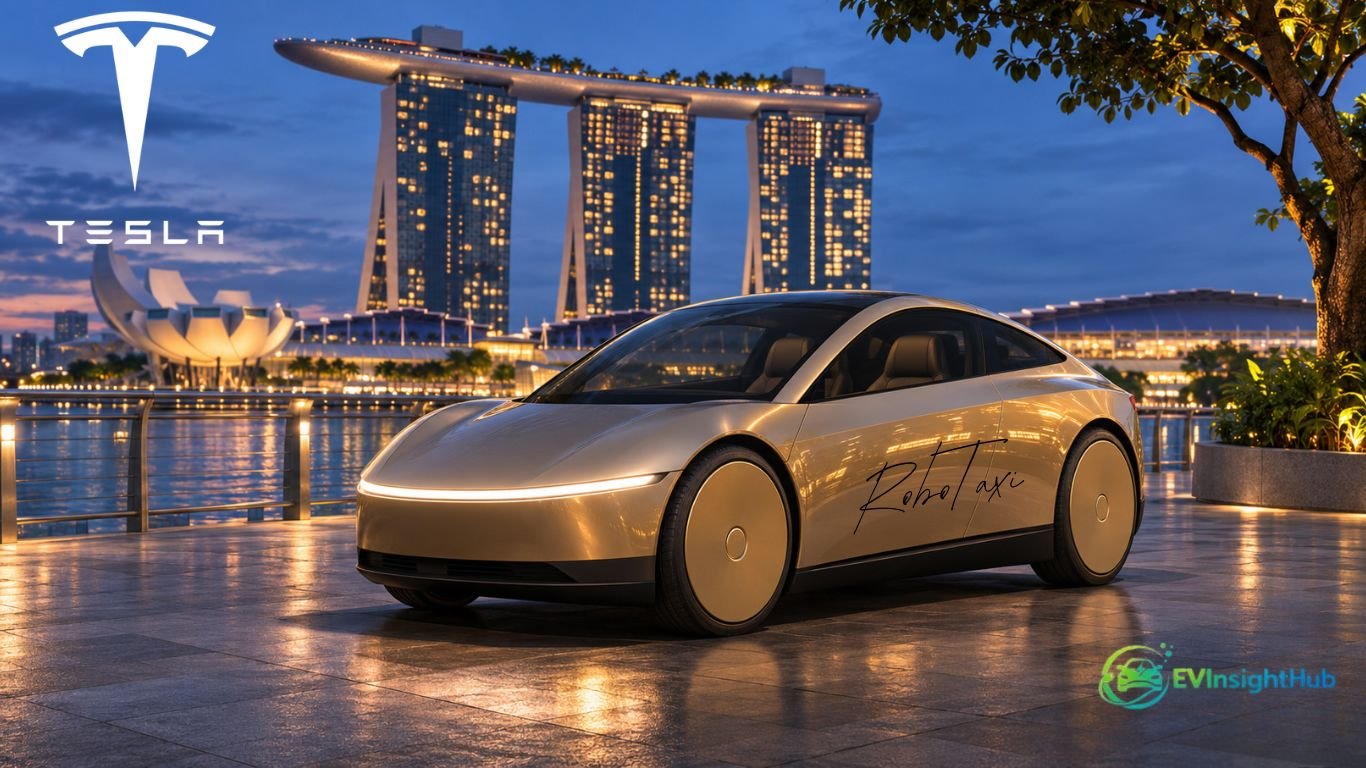
Tesla Robotaxi is Tesla’s driverless ride-hailing service. It now runs without a safety monitor in eight US cities, using Model Y cars and the purpose-built Cybercab. On November 13, 2026, Tesla also invited select customers to buy a Cybercab for personal use at $29,990, plus a mandatory $299 per month autonomy subscription. First deliveries are expected in December 2026, starting in Austin, Texas.
In short, the robotaxi is no longer a concept-stage promise. You can ride one today in Texas and Florida, and soon a few owners will park one in their driveway. Still, big questions remain on safety rules, costs and how far Tesla can scale this Self-Driving cybercab .
Tesla Robotaxi Overview
| Detail | Latest status (November 2026) |
|---|---|
| Service | Tesla Robotaxi, booked through the Robotaxi app |
| Driverless cities | Austin, Houston, Dallas, Fort Worth, San Antonio, Miami, Orlando, Tampa |
| Vehicles | Model Y and the two-seat Cybercab |
| Cybercab rides | Open to the public in Austin since September 4, 2026 |
| Cybercab price | $29,990, invite-only personal orders |
| Autonomy subscription | $299 per month, required to use the car |
| First owner deliveries | Expected December 2026 |
| Built at | Gigafactory Texas, Austin |
What Is Tesla Robotaxi?
A robotaxi is a car that drives paying passengers with no human driver at the wheel. Tesla Robotaxi is Elon Musk’s version of that idea. You open an app, request a ride, and an autonomous Tesla picks you up.
The service started in Austin on June 22, 2025, using modified Model Y cars with human safety monitors on board. Then, in January 2026, Tesla began unsupervised public rides in Austin, with no employee in the car. Since then, the network has grown quickly across Texas and Florida.
Today, Tesla’s robotaxi plan has three parts:
- The ride-hailing network, where anyone in a service area can book a trip.
- The Cybercab, a two-seat car built only for autonomous driving.
- Personal ownership, where select buyers can own a Cybercab and pay a monthly autonomy subscription.
As a result, Robotaxi is now one of the most closely watched autonomous vehicles programs in the world, alongside Waymo, Zoox and China’s fast-growing robotaxi players.
Cybercab Tesla: Design, Interior and Specs
The Cybercab is Tesla‘s first car with no steering wheel and no pedals. Elon Musk first showed it at the “We, Robot” event in October 2024. Since then, it has moved from a stage prop to a production car.
Exterior and the famous gold finish
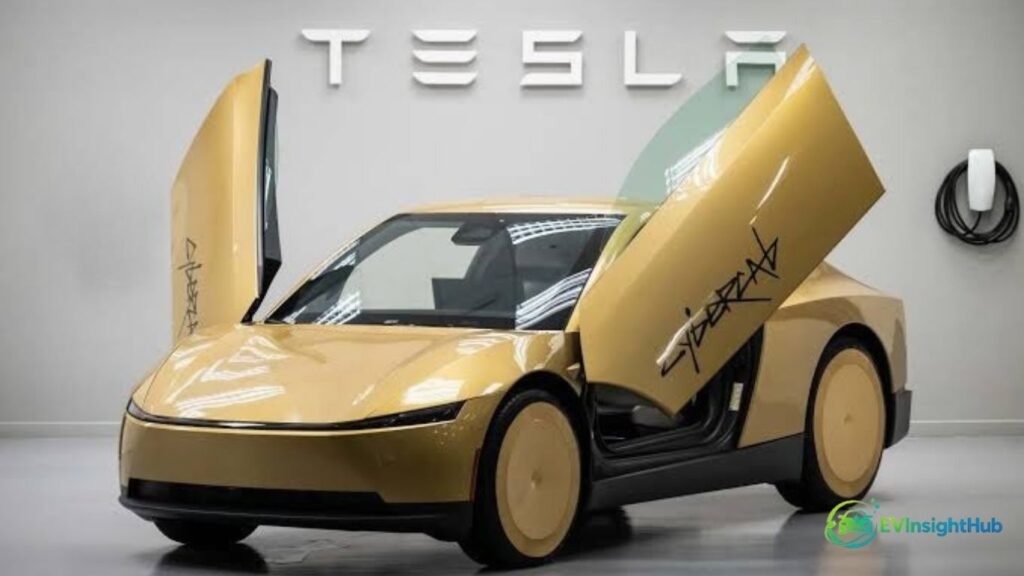
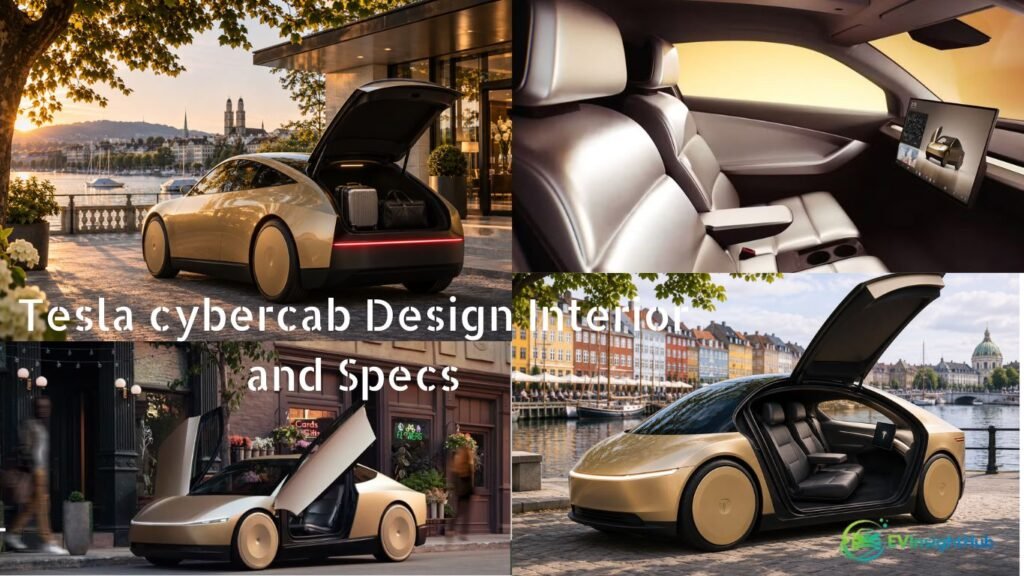
The Cybercab is a compact two-door coupe with butterfly doors and sharp, Cybertruck-style lines. Its gold, champagne-like paint has become the car’s signature look, which explains why “robotaxi Tesla gold” is such a common search. There is no charging port, because the car charges wirelessly over an inductive pad. Tesla targets a charging efficiency above 90%.
Interior: built for passengers, not drivers
Inside, you get two seats, a large screen and plenty of luggage space. Since there is no steering wheel, riders control the trip through the Robotaxi app and the in-car display. The cabin also includes a support button that connects to Robotaxi Support and a mechanical door release for emergencies. For now, children under 13 cannot ride in a Cybercab.
Cybercab specifications
Tesla’s EPA filings, reported by Teslarati in June 2026, revealed the key numbers:
| Specifications | Cybercab Details |
|---|---|
| Seats | 2 |
| Battery | About 48 kWh |
| Motor | Single 163 kW (219 hp), front-wheel drive |
| EPA lab range | 418 miles combined (real-world estimate: about 280 to 300 miles) |
| Curb weight | 3,113 lb |
| Charging | Inductive (wireless), no plug |
| Controls | No steering wheel or pedals |
Tesla Robotaxi Price: Can You Buy a Cybercab?
Yes, but only by invitation for now. On November 13, 2026, Robotaxi account announced that selected customers in supported locations could order a Cybercab for personal use. musk has not given a date for wider sales.
What the Cybercab really costs
- Vehicle price: $29,990 before taxes and other fees.
- Deposit: $1,000, non-refundable.
- Autonomy subscription: $299 per month, and it is mandatory. The first month is included, so a full year after that costs $3,588.
The subscription covers the autonomous driving technology, connectivity, remote support, roadside assistance and some scheduled maintenance. Meanwhile, owners pay for insurance, registration, parking, charging and cleaning. Elon can also change the subscription price with one month’s notice.
Interestingly, Musk himself called $299 too high. He suggested a future price closer to about $115 a month, roughly what Full Self-Driving and connectivity cost on other car. For now, though, the $299 terms apply.
The catch: rules every buyer should know
This is not a normal car purchase. Before ordering, consider these limits:
- The car cannot drive on public roads without an active subscription.
- If the subscription lapses, you cannot switch to manual driving, because there are no controls.
- It works only inside the same areas as Robotaxi service, according to Tesla AI chief Ashok Elluswamy.
- You cannot add it to the Robotaxi network to earn money, and ride-hailing, rental or delivery use needs Tesla’s permission.
- Elon can suspend autonomous access if you break its usage and safety terms.
So, the Cybercab is closer to a subscription-based personal shuttle than a traditional car. For buyers who live inside a service area, that could be very convenient. For everyone else, it is not yet an option.
Robotaxi Tesla Release Date
Tesla’s robotaxi has missed plenty of deadlines over the years. However, 2026 is the year the hardware finally arrived. Here is how it unfolded:
- October 2024: Musk unveils the Cybercab at the “We, Robot” event and promises a price under $30,000.
- June 22, 2025: Robotaxi rides begin in Austin with safety monitors in Model Y cars.
- January 2026: Unsupervised public Model Y rides start in Austin.
- February 17, 2026: The first production Cybercab rolls off the line at Gigafactory Texas.
- April 2026: Volume production of the Cybercab begins.
- September 4, 2026: Cybercab rides open to the public in Austin.
- November 2 and 9, 2026: Fort Worth and San Antonio join the network.
- November 13, 2026: Invite-only personal orders open at $29,990.
- December 2026: First owner deliveries expected, starting in Austin.
Looking ahead, Musk has said wider availability depends on regulatory approval. Electrek also reports that Tesla has tied a major fleet ramp to Full Self-Driving v15, targeted for late 2026 or early 2027.
Robotaxi Locations: Where Can You Ride?
As of mid-November 2026, Tesla runs unsupervised Robotaxi service in eight US cities:
| City | State | Notes |
|---|---|---|
| Austin | Texas | First city; Cybercab rides since September 2026 |
| Houston | Texas | Service area grown to about 254 sq. miles |
| Dallas | Texas | Focused urban zone |
| Fort Worth | Texas | Launched November 2, 2026 |
| San Antonio | Texas | Launched November 9, 2026 |
| Miami | Florida | Live |
| Orlando | Florida | Live |
| Tampa | Florida | Live |
Musk also operates in the San Francisco Bay Area, but with a safety driver, as California law requires. In addition, trackers list Las Vegas, Phoenix and Jacksonville as announced but not yet live.
The Robotaxi App: How to Book a Ride
Booking works much like Uber or Lyft:
- Download the Tesla Robotaxi app on iOS or Android.
- Open it inside a supported service area.
- Enter your destination and check the fare and wait time.
- Choose a Model Y or, in Austin, a Cybercab.
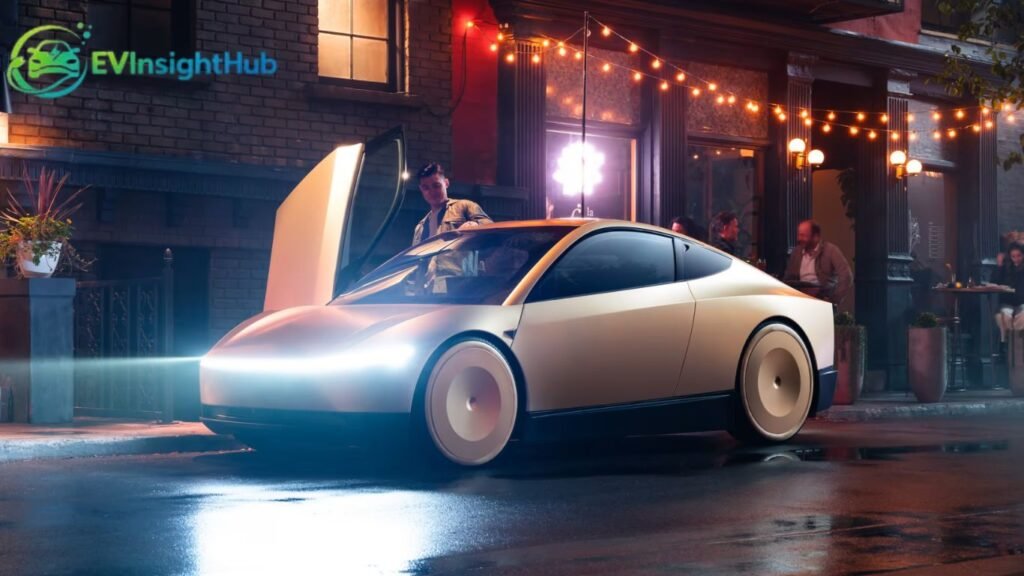
- When your Cybercab arrives, its front light bar glows a unique colour so you know it is yours.
Groups of three or more need a Model Y, since the Cybercab seats only two. Price is a strong pull, too. In one early Austin comparison shared on X, the same trip cost $7.77 in a Cybercab versus $12.10 in a Model Y.
How Tesla Robotaxi Works: Full Self-Driving Explained
Every Tesla robotaxi runs on the same core software: Tesla’s Full Self-Driving (FSD) system. However, it’s approach differs sharply from most rivals.
Cameras and AI, not lidar
Tesla relies on cameras and a neural network trained on video from millions of customer cars. In contrast, Waymo and Zoox add lidar and radar sensors, plus detailed maps. Tesla argues its vision-only design is cheaper and easier to scale. Critics, on the other hand, question whether cameras alone can handle every edge case, such as heavy rain or glare.
From supervised FSD to unsupervised robotaxi
On a regular Tesla, FSD (Supervised) still needs an alert driver ready to take over. Robotaxis run an unsupervised version inside approved zones, called geofences. Remote operators can help a car that gets stuck, but nobody sits behind the wheel. Indeed, in the Cybercab there is no wheel at all.
Why geofences matter
Geofences let Tesla test and validate the software city by city. That is why the service expands in steps, as with Houston’s recent jump from about 25 to 254 square miles. It also explains why personal Cybercabs will only work inside those same zones at first.
In simple terms, the more miles the fleet drives, the more data Tesla collects, and the faster it can open new areas. That feedback loop sits at the heart of Musk’s robotaxi bet.
Tesla Robotaxi vs. Waymo and Other Autonomous Vehicles
Tesla is not alone in the robotaxi race. In fact, it is still chasing the leader.
| Company | Vehicle | Approach | Scale (latest reported) |
|---|---|---|---|
| Tesla Robotaxi | Model Y, Cybercab | Cameras + AI | 8 unsupervised US cities |
| Waymo (Alphabet) | Jaguar I-PACE, Zeekr, Hyundai Ioniq 5 | Lidar, radar, cameras | 500,000 paid rides a week across 10 US cities (March 2026) |
| Zoox (Amazon) | Purpose-built, no steering wheel | Lidar, radar, cameras | Commercial service in Las Vegas |
Waymo has a clear head start. It reached 500,000 paid rides a week in March 2026 and aims for 1 million a week by the end of the year, with London and Tokyo next. Zoox, meanwhile, was the first to win US approval to carry paying riders in a steering-wheel-free vehicle.
So where does it stand out? Mainly on cost and speed of rollout. A sub-$30,000 purpose-built car is far cheaper than most sensor-heavy robotaxis. Musk also added Fort Worth and San Antonio within a single week in November 2026. If FSD keeps improving, that cost edge could matter a great deal.
Is Tesla Robotaxi Safe?
Safety is the biggest test for any robotaxi. By early September 2026, Tesla’s unsupervised robotaxis had logged about 1 million miles, according to EVwire. That is real progress, yet it is still small next to Waymo’s track record.
Regulators are watching closely. On September 10, 2026, the US National Highway Traffic Safety Administration (NHTSA) sent Tesla a special order with 21 questions on how it certified the Cybercab. More recently, NHTSA asked Tesla to clarify how the car meets federal safety rules. Neither step has stopped Cybercab service, but the answers will shape how fast personal sales can grow.
Rules also vary by place. For instance, California still requires a safety driver, while Texas and Florida allow driverless service. Outside the US, robotaxi rules differ widely, so a global rollout will take time.
Robotaxi Tesla Investment: What It Means for Tesla
Many investors see Robotaxi as central to Tesla’s long-term story. Musk has described the Cybercab mainly as “transport as a service” rather than a car most people will own. If the network scales, Tesla could earn recurring revenue from rides and $299 monthly subscriptions, not just one-time car sales.
Still, the risks are real: regulatory delays, safety incidents, strong competition from Waymo and the cost of building charging and support hubs. This section is for information only and is not financial advice. Always do your own research or speak to a licensed adviser before investing.
Tesla Robotaxi in 6 Shareable Numbers
- $29,990: the Cybercab’s personal purchase price.
- $299: the monthly autonomy subscription every owner must pay.
- 8: US cities with driverless Tesla Robotaxi service.
- 0: steering wheels and pedals in a Cybercab.
- 418 miles: the Cybercab’s EPA lab range from a battery of about 48 kWh.
- $7.77 vs $12.10: one Austin trip in a Cybercab versus a Model Y.
Final Thoughts: Is the Robotaxi Future Finally Here?
For years, Tesla’s robotaxi lived mostly in slides and promises. In 2026, it became real. Driverless Model Ys now carry riders across eight cities, the Cybercab rolls off the line in Texas, and a few buyers can now order one for $29,990.
That said, the model is new and comes with strings attached. You need a $299 monthly subscription, you can only use the car inside Tesla’s zones, and regulators still have open questions. So, the smartest move for most people today is to try a ride first, then watch how the rules and prices change through 2027.
Want more on Tesla’s bold ideas? Read our deep dive on Tesla’s flying car: what’s real, what it costs and what’s next, or see how the Alef Model A flying car compares with the Tesla Roadster.
FAQs About Robotaxi
Tesla Robotaxi rides began in Austin on June 22, 2025, and unsupervised rides followed in January 2026. Cybercab rides opened to the public on September 4, 2026, and first owner deliveries are expected in December 2026.
The Cybercab costs $29,990 for invited buyers, plus a $299 monthly autonomy subscription. Ride fares vary by trip; one Austin Cybercab ride cost $7.77.
Only by invitation right now. Selected customers in supported areas can order a Cybercab with a $1,000 non-refundable deposit. Tesla has not announced wider sales.
Driverless service runs in Austin, Houston, Dallas, Fort Worth, San Antonio, Miami, Orlando and Tampa. The San Francisco Bay Area has service with a safety driver.
No. The Cybercab has no steering wheel or pedals, so it cannot be driven manually.
It is a mandatory $299 monthly plan for Cybercab owners. It covers self-driving software, connectivity, remote support, roadside assistance and some maintenance.
Alos Read about: Tesla: Electric Cars
Tesla Model 3 vs Model Y Comparison: Performance, Range, Specs & Price

