


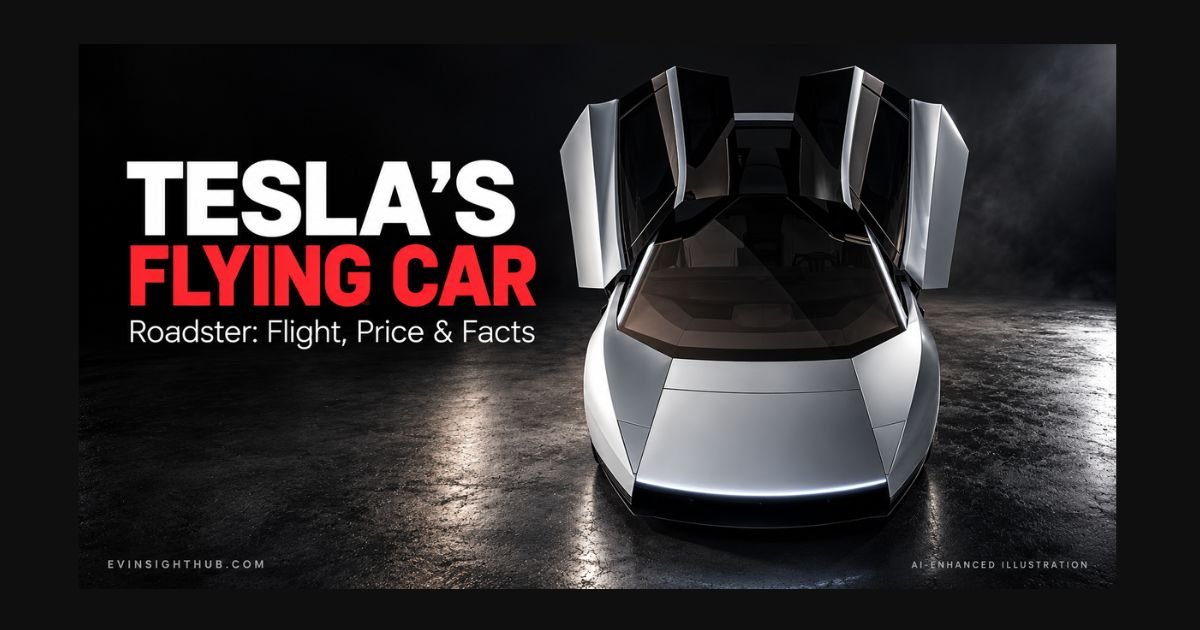
Tesla’s Flying Car: What’s Real, What It Costs and What’s Next
Tesla’s flying car raises a question that a spectacular video alone cannot answer: what does getting a car into the air actually mean for its future owner?
The vehicle behind the headlines is the next-generation Tesla Roadster. Its October 2026 demonstration attracted attention for brief airborne maneuvers. However, the evidence reviewed does not establish a vehicle capable of routine, sustained aerial travel. Aviation Week described the demonstration as a short hop with an axial roll using SpaceX-developed cold-gas thrusters. Aviation Week
For readers, three questions matter: what was demonstrated, what Tesla intends to deliver, and what customers would actually be allowed to use.
Information verified as of October 22, 2026. Some product details remain under development; limitations are identified below.
Key takeaways
- Airborne demonstration footage does not establish practical point-to-point flight.
- Roadster features vary by configuration; readers should check which version a claim describes.
- A reservation payment should never be presented as the vehicle’s final purchase price.
- Tesla and Alef are pursuing different ideas under the broad “flying car” label.
What is Tesla’s flying car called?
The vehicle is the Tesla Roadster, rather than a separate production model officially named “Tesla Flying Car.”
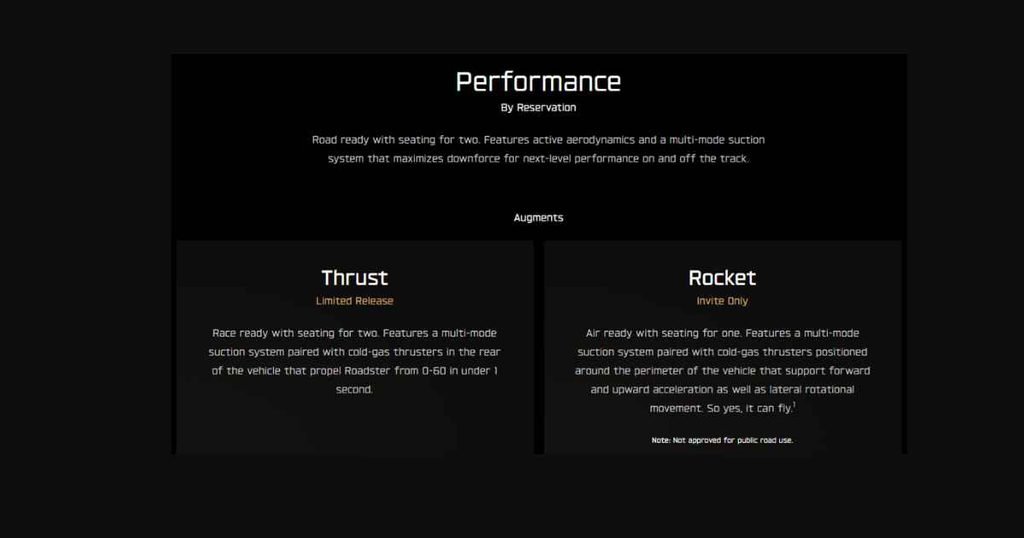
Tesla’s own website identifies the Roadster and includes configuration-specific qualifications for the Thrust upgrade and Rocket trim. That matters because a dramatic feature associated with one configuration should not automatically be attributed to every Roadster. Tesla
When comparing articles, reservation pages, or videos, check the vehicle name and configuration together. A headline about the Roadster family may describe equipment that a particular customer’s car will not have.
Is Tesla’s flying car real or fake?
The demonstration is supported by reporting from established news organizations. Associated Press reported that Tesla showed the new Roadster at a Texas event, where the vehicle performed short airborne movements and rotations. apnews.com
That supports the existence of a demonstrated vehicle. It does not authenticate every image or clip subsequently shared online.
It also leaves a larger question unresolved: how far does the demonstrated capability extend?
For this article, a useful distinction is between:
| Capability | What it establishes |
|---|---|
| Leaving the ground | The vehicle can become airborne under the demonstrated conditions |
| Controlling an airborne maneuver | Some control over movement or orientation during that demonstration |
| Sustained flight | Continued controlled aerial travel beyond a short maneuver |
| Practical customer operation | Repeatable use with documented limits, appropriate permissions, and customer support |
These are separate evidence thresholds. Crossing one does not automatically satisfy the others.
A reader watching a short clip should therefore ask about duration, operating conditions, vehicle configuration, and whether the footage shows a demonstration vehicle or a delivered customer car.
How does Tesla’s flying car work?
Tesla describes the Roadster’s technology as using cold-gas thrusters with electrically operated actuators that make rapid thrust adjustments. Its product description also identifies SpaceX components as part of the enhanced performance system.
Tesla Roadster “Flying Car” specifications — checked October 23, 2026
The redesigned Roadster remains under development. The figures below are manufacturer claims or development targets, not independently verified production-car results. Tesla’s agreement confirms that final hardware, pricing, and delivery remain unsettled.
| Specification | Details available | Verification status |
|---|---|---|
| Model | Next-generation Tesla Roadster, redesigned for the October 2026 reveal | Prototype intended for production |
| Vehicle type | Battery-electric sports car with optional cold-gas thruster systems | Described by Tesla executives |
| Configurations presented | Performance, Thrust, Rocket | Announced configurations; final equipment may change |
| Electric motors | Two rear-mounted motors | Disclosed during MotorTrend’s direct briefing with Tesla |
| Drive layout | Rear-wheel drive | Executive briefing; differs from the earlier 2017 concept |
| Power output | Approximately 1 megawatt / 1,000 kW for the higher-performance versions | Development claim; approximately 1,341 mechanical hp |
| Battery cells | Tesla 4680-format lithium-ion cells | Disclosed in executive briefing |
| Battery capacity | Exact production capacity not publicly finalized | Do not publish a definitive kWh figure |
| Road driving range | More than 300 miles / approximately 483 km claimed | Not a verified EPA-certified range |
| Charging | Approximately 500 kW capability discussed | Development specification; final charging curve unverified |
| Weight | Approximately 1,700 kg target | Not a confirmed curb weight for every configuration |
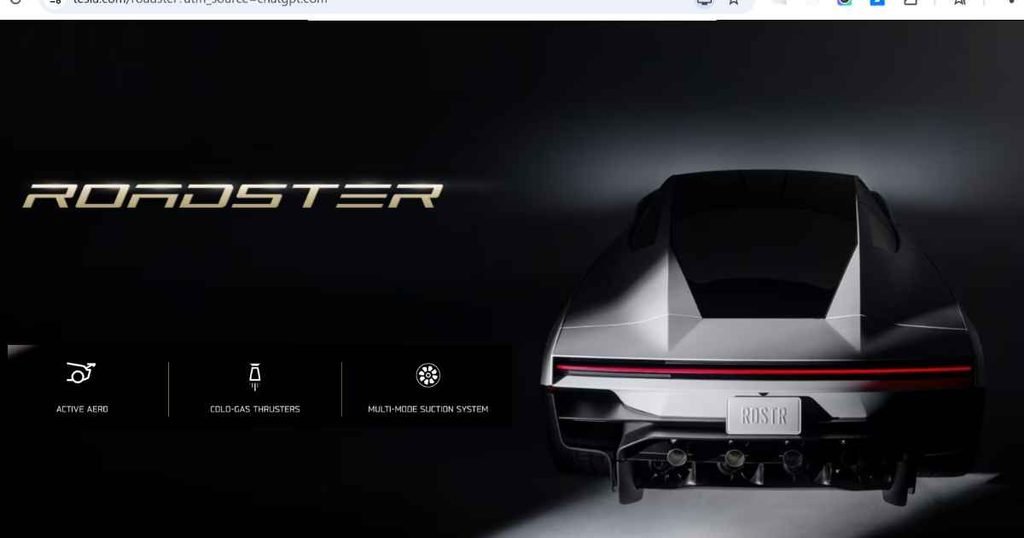
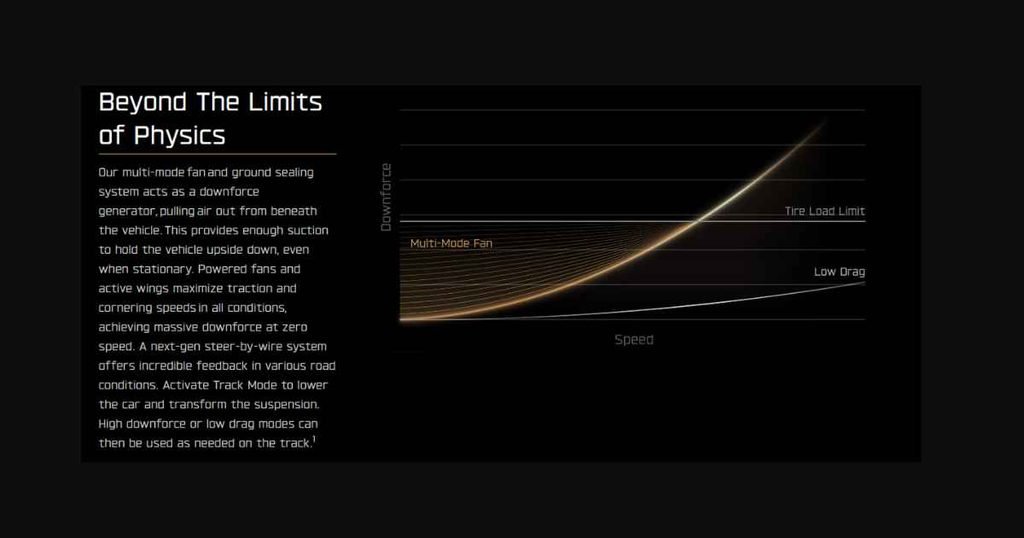
| Aerodynamics | Active aerodynamic surfaces and fan-assisted suction system | Demonstrated/described; configuration dependent |
| Brakes | Carbon-ceramic brakes discussed | Development equipment |
| Roof and doors | Removable T-top roof panels and butterfly-style doors | Observed on the prototype |
| Production timing | 2028 target | Not a guaranteed customer delivery date |
The useful takeaway is that the unusual movement involves additional propulsion hardware. It should not be confused with an ordinary electric car gaining an airborne mode through a software update.
Configuration comparison
| Feature | Performance | Thrust | Rocket |
|---|---|---|---|
| Seating | 2 | 2 | 1 |
| Claimed 0–60 mph acceleration* | Under 1.6 seconds | Under 0.9 seconds | Under 0.59 seconds |
| Cold-gas thrusters | No additional thruster package | 4 rear thrusters | 10 thrusters in total |
| Pressure-vessel volume | Not applicable | Approximately 200 litres | Approximately 600 litres |
| Intended thruster function | Not applicable | Additional forward acceleration | Forward thrust, lift, and rotational control |
| Airborne capability | Not established | Do not describe as the flying configuration | Brief airborne maneuvers demonstrated |
| Final purchase price | Unconfirmed | Unconfirmed | Unconfirmed |
The acceleration figures are Tesla’s published claims reproduced in launch coverage; hardware details come from direct executive briefings. Electrek
0–60 mph means approximately 0–96.6 km/h, not 0–100 km/h. Test conditions and rollout treatment must be checked before comparing these figures with other vehicles.
Disclaimer: Specifications reflect information available as of October 23, 2026, including Tesla’s announcements and executive statements reported by automotive publications. The next-generation Roadster remains under development. Performance, range, charging, and weight figures are manufacturer claims or targets—not independently verified production-vehicle results—and may change. Demonstrated airborne maneuvers do not establish sustained flight capability or authorization for airborne use on public roads. Features and availability may vary by configuration and market. Reservation payments are not final purchase prices and do not guarantee delivery. Consult Tesla’s latest official specifications and applicable reservation terms before making a purchase decision.
Does the Tesla flying car use fuel?
“Tesla flying car fuel” combines two different questions: how the vehicle drives and how its additional thrusters operate.
Tesla identifies the Roadster as an electric sports car and describes the extra system as cold-gas propulsion. Those descriptions do not justify calling it a gasoline-powered flying car or assuming it burns conventional rocket fuel.
For a prospective owner, more useful questions concern replenishment, maintenance, operating limits, and which functions remain available in their region. Those details should come from documentation for the final vehicle configuration.
Tesla flying car price: separate the deposit from the purchase
Reuters reported US reservation deposits of $50,000 for Performance and $250,000 for Thrust, with production targeted for 2028. These are reported reservation amounts and a production target, respectively. reuters.com
Tesla’s US Roadster reservation agreement, version dated October 15, 2026, supplies the more consequential distinction: a reservation establishes approximate priority but does not constitute a vehicle purchase or order.
The agreement also says the exact price remains unsettled while features and hardware are being developed. Tesla does not guarantee when—or whether—the reserved vehicle will be delivered.
That makes a headline such as “Tesla flying car costs $50,000” misleading if it uses a reservation payment as the selling price.
What should buyers check before reserving?
Start with the agreement applicable to your country and the exact configuration you select.
Check:
- The full reservation payment and payment deadlines.
- Cancellation and refund conditions.
- Whether a price is final or estimated.
- The delivery commitments, if any.
- Which features are available in your market.
Tesla’s US agreement permits cancellation and a refund before the configuration stage described in the document. It also states that reservation money is not held separately in escrow and earns no interest. These are US terms; readers elsewhere should review their local agreement.
Tesla flying car price in India: what do the rupee figures mean?
There is a meaningful difference between an Indian reservation amount and an Indian on-road price.
Mint reported on October 21, 2026, that Roadster reservations in India involved approximately ₹50.06 lakh for Performance and ₹2.50 crore for Thrust. Its report identified these as reservation deposits and said final prices and delivery dates had not been confirmed. Mint
The live Indian reservation form did not expose its amounts during this research, so these figures should be treated as attributed reporting rather than a directly verified checkout quotation.
A currency conversion is also insufficient to establish an on-road price. Readers looking for “Tesla flying car price in rupees” need to know exactly what a figure represents before comparing it with another vehicle.
For booking enquiries, use Tesla’s official Indian Roadster reservation page and review the current local terms.
When will Tesla’s flying car launch?
“Launch” can describe an unveiling, reservation opening, production start, or customer delivery. These events should be dated separately.
The October 2026 unveiling has taken place. AP reported that Musk identified 2028 as the intended start of consumer production. That does not establish a guaranteed delivery date for an individual customer or country. apnews.com
For someone considering a purchase, a model-specific delivery commitment matters more than an event headline.
Until final customer documentation is available, avoid treating a production target as an appointment to collect the vehicle.
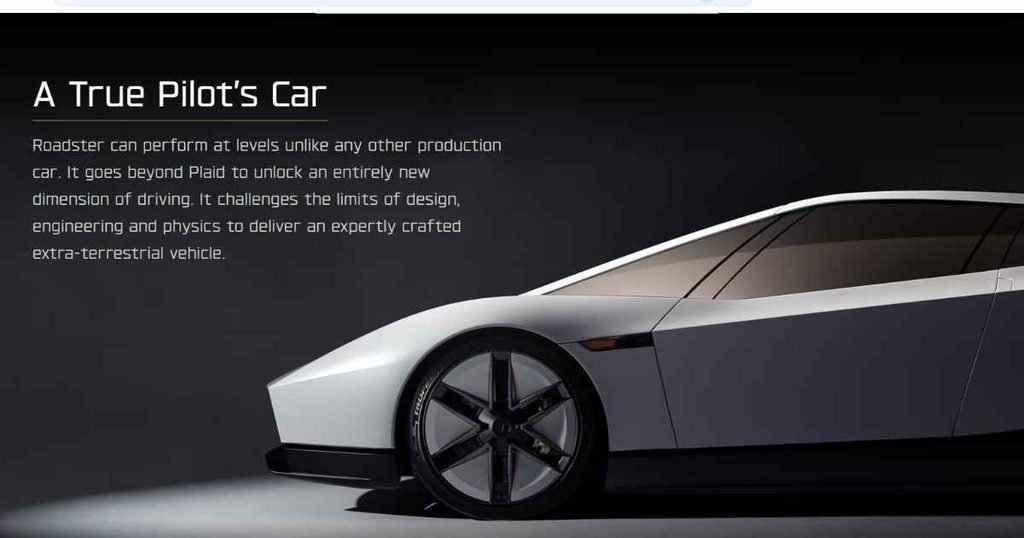
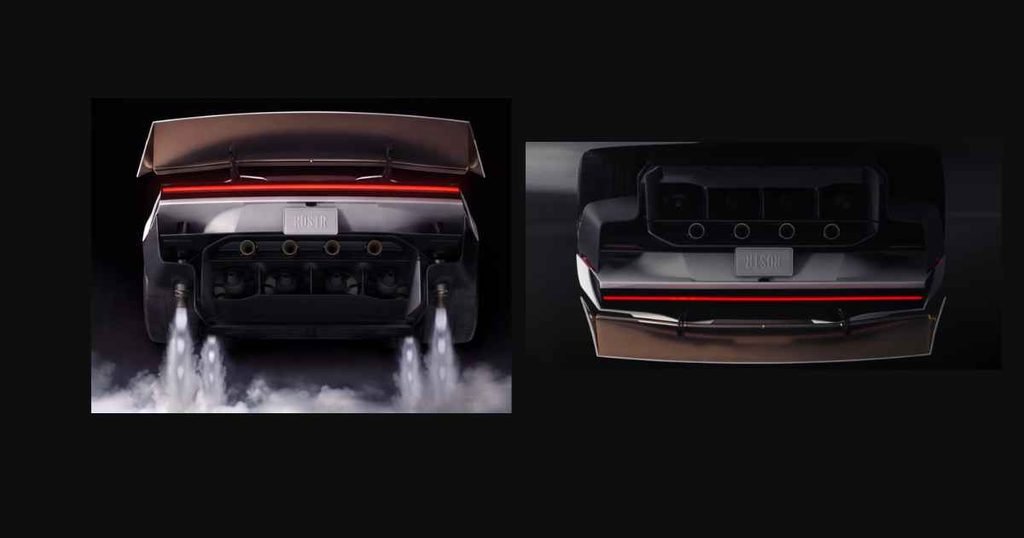
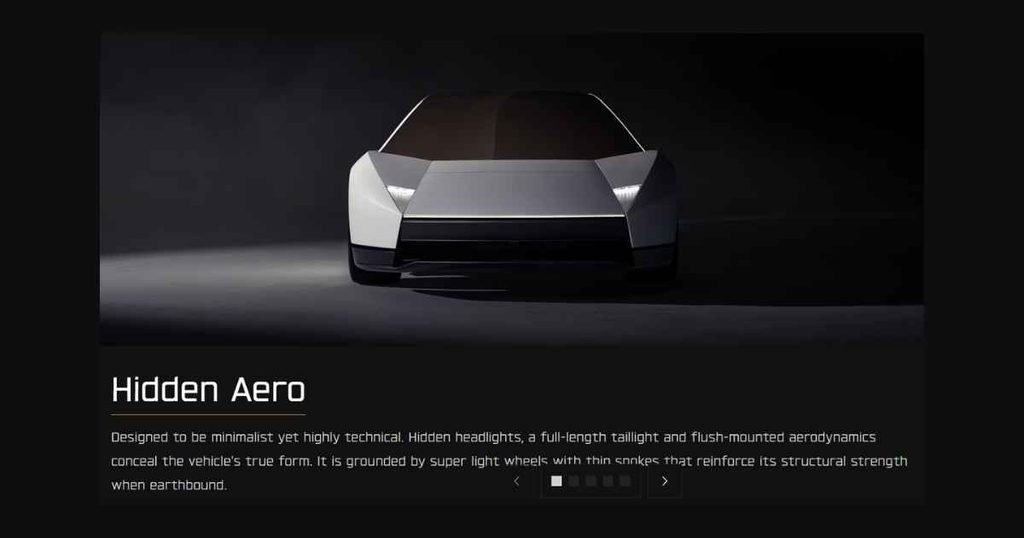
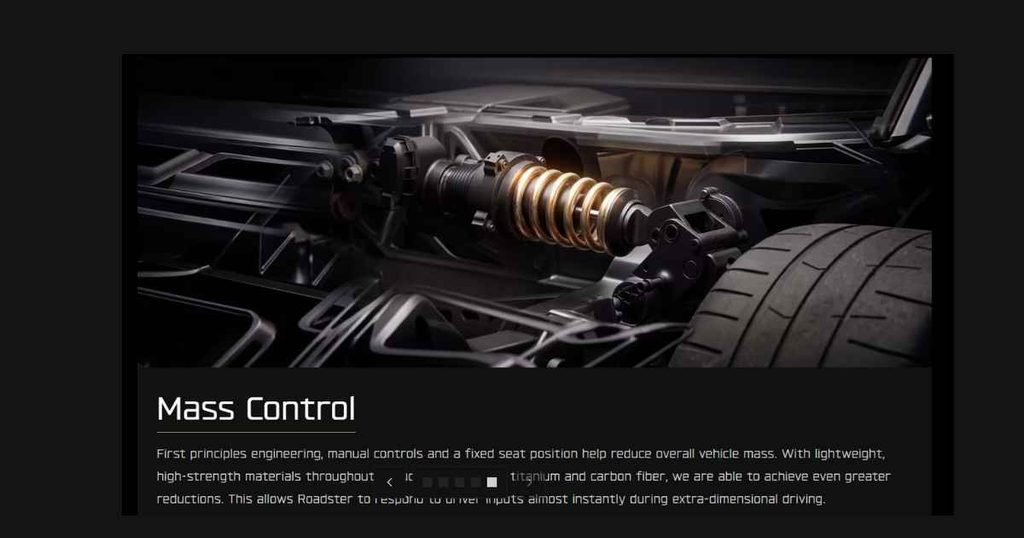
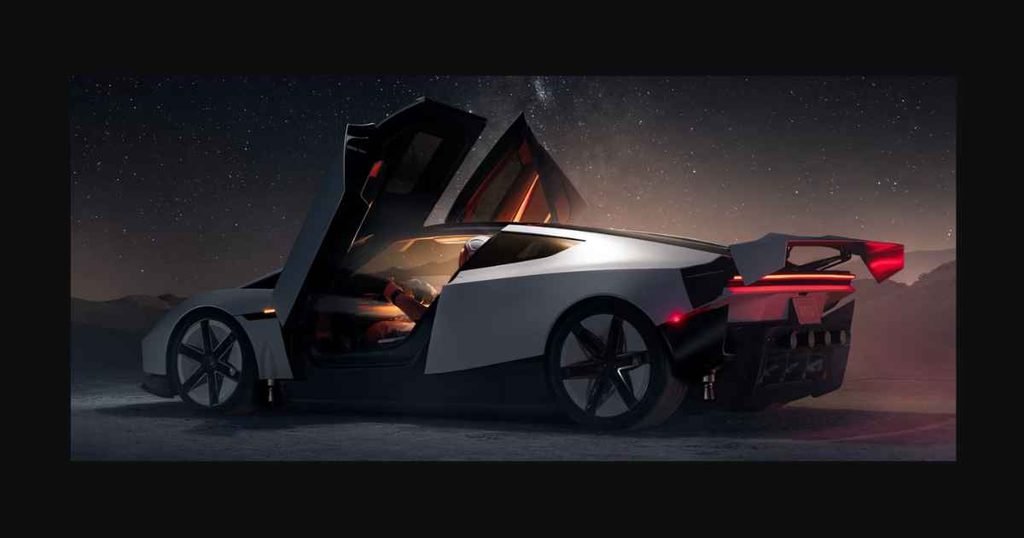
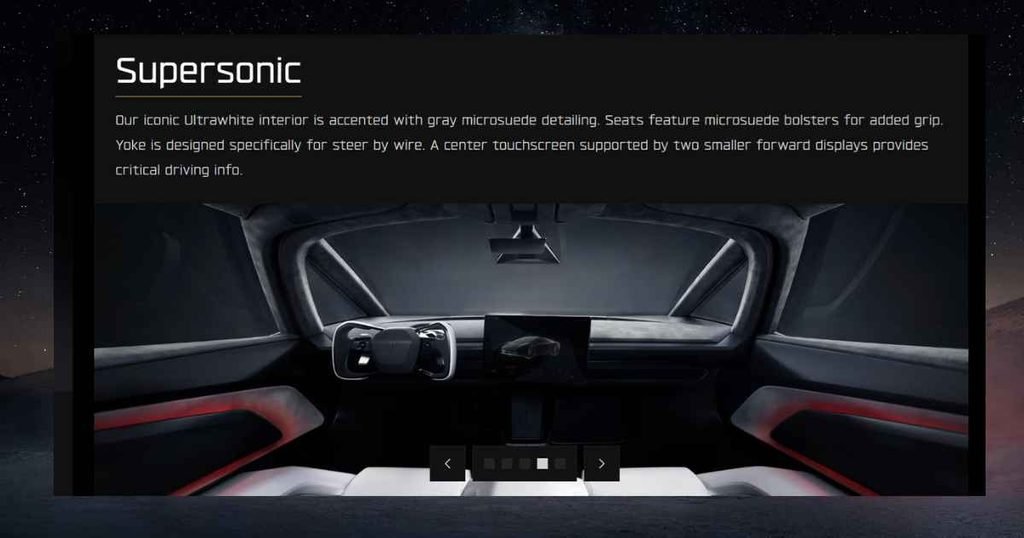
Here are some of imags taken from its official site.
Tesla’s flying car vs Alef: what is the difference?
The phrase “flying car” covers products with different purposes.
Alef model A describes its vehicle as designed to drive on streets, take off vertically, and fly above traffic. That is the manufacturer’s stated design objective, rather than proof that every intended use is currently available to customers. alef.aero
Tesla’s reported demonstration focused on a Roadster performing short airborne maneuvers. This makes the comparison more useful when it examines intended use instead of declaring a winner.
| Question | Tesla Roadster | Alef flying-car project |
|---|---|---|
| What is the central concept? | Electric sports car with configuration-dependent performance hardware | Vehicle designed for road travel and vertical takeoff |
| What should readers investigate? | Which demonstrated functions reach customer vehicles | Which flight capabilities and operating conditions are approved |
| What should a buyer compare? | Final configuration, usable features, and delivery terms | Final configuration, flight limitations, and delivery terms |
| What would be misleading? | Assuming every Roadster can perform the demonstration | Assuming the design objective permits unrestricted everyday flying |
For the other side of this comparison, explore our Alef flying car guide, covering the company’s project, tests, and stated ambitions.
Why flight permissions matter
An impressive demonstration cannot, by itself, tell a customer where a vehicle may operate.
The FAA explains that special airworthiness certificates authorize operation within defined categories. For experimental aircraft, federal operating rules include restrictions tied to the purpose of the certificate and limitations on operations over densely populated areas unless specifically authorized. Federal Aviation Administration
This does not establish how regulators will classify every future Roadster configuration. It explains why phrases such as “FAA-approved flying car” require precise supporting documentation.
The practical questions are specific: Which vehicle? Which certificate? Which operation? Which location?
Without those answers, a broad approval claim tells a reader very little.
What evidence should come next?
The most useful next development would be documentation connecting the demonstration to customer use.
EVInsightHub’s assessment is that readers should watch for five things:
- Final specifications identifying each configuration’s capabilities.
- Independent testing with disclosed conditions and repeatable results.
- Operating limits explaining where and how unusual features can be used.
- Final pricing clearly separated from reservation payments.
- Customer deliveries supported by owner documentation.
This framework also works for other emerging vehicles. It helps distinguish an engineering achievement from a finished ownership proposition without dismissing either.
What Tesla’s flying car means for readers
Tesla’s flying car deserves scrutiny because it challenges familiar expectations about what a sports car can do. The useful discussion now concerns how that demonstrated capability translates into a product.
Keep three milestones separate: a demonstration, a delivered vehicle, and permission to use its features.
If someone shares a flying-car video with you, look for the configuration, source, and operating context before drawing conclusions. Share this guide with readers comparing the claims, or explore our coverage of Alef’s flying-car project to understand the competing approach.
FAQ section
The vehicle is the next-generation Tesla Roadster. “Tesla flying car” is a descriptive search phrase; equipment and capabilities depend on configuration
The reviewed evidence supports short airborne maneuvers. It does not establish sustained, long-distance aerial travel by a customer-ready Tesla Roadster.
Tesla’s reviewed US reservation agreement does not confirm an exact purchase price. Reservation payments must be distinguished from the final vehicle price.
Indian reservations were reported in October 2026. Check Tesla’s current Indian reservation page for availability and local terms; a reservation is not proof of an assured delivery date.
No. Tesla’s Roadster demonstration involves brief airborne maneuvers, while Alef describes a vehicle designed for road travel, vertical takeoff, and aerial travel. Their intended uses differ.

